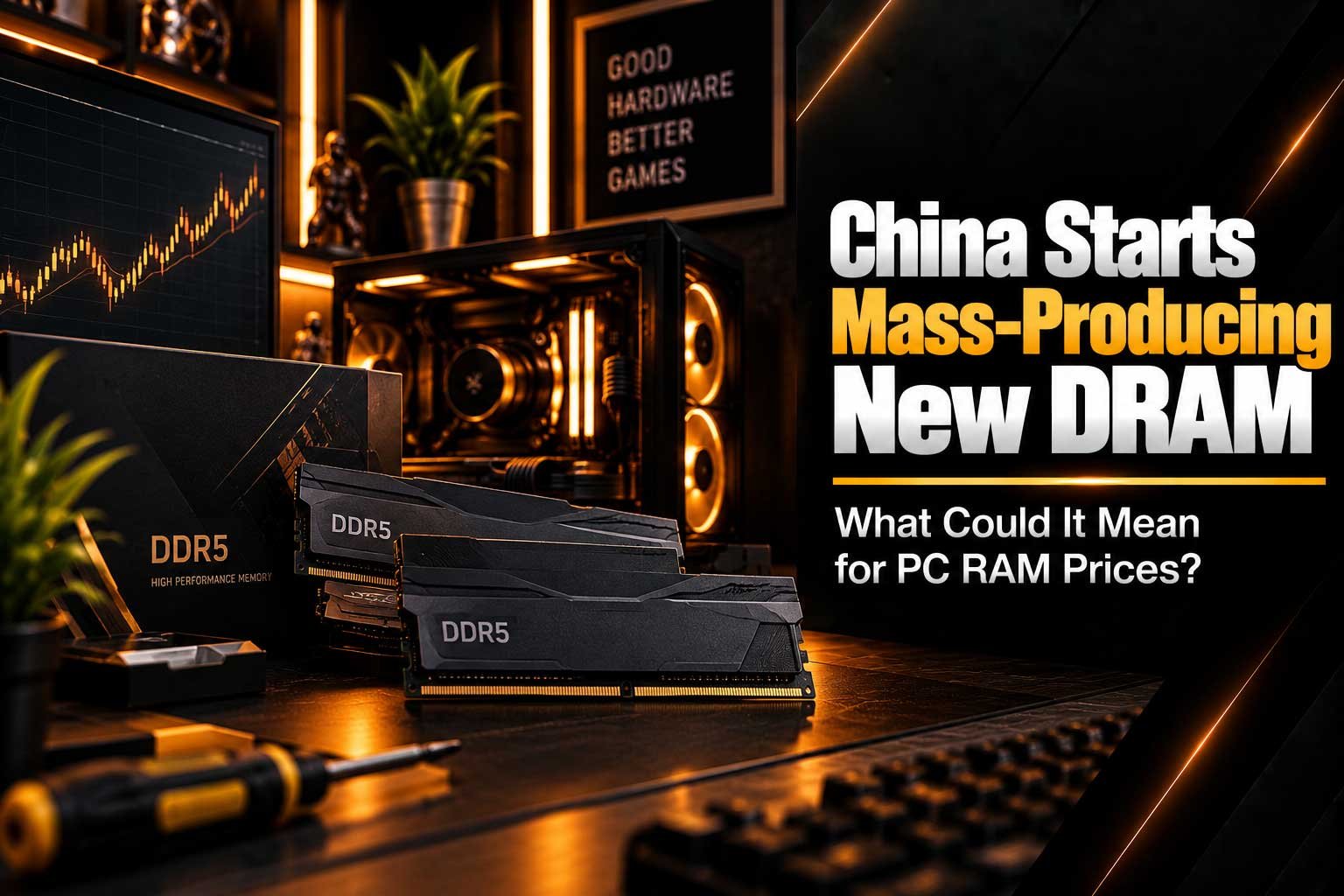
China has started mass-producing a new generation of DRAM memory, potentially adding a major new source of supply to the global memory market. Find out what the new China DRAM production means for DDR5 RAM prices, the ongoing memory shortage, and PC buyers in 2026.
- China's new DRAM production and what has changed
- How CXMT's new technology could affect DDR5 RAM supply
- Why RAM prices remain high in 2026
- What the new DRAM production could mean for PC RAM prices
- How increased competition could affect the global memory market
- What PC buyers should know before upgrading to DDR5 memory
- Whether the new production could eventually help reduce RAM prices
China's New DRAM Production Could Change the Memory Market
China's memory industry has reached an important milestone that could have implications for the global DRAM market. ChangXin Memory Technologies (CXMT) has announced that its fifth-generation DRAM platform has entered mass production, introducing a newer manufacturing process designed to increase memory density and production efficiency. The company says its new G5 process can produce at least 50% more gross dies per wafer than its previous generation. The first disclosed products include 24Gb LPDDR5X memory chips, primarily targeting mobile devices. While this does not immediately mean cheaper desktop RAM, it represents another significant source of memory production at a time when the global market is dealing with tight supply and strong demand. For PC buyers, the development is worth watching because changes in DRAM manufacturing can eventually influence the availability and cost of DDR5 memory.
What Is CXMT and Why Does Its New DRAM Matter?
CXMT, or ChangXin Memory Technologies, is a major Chinese DRAM manufacturer that has been expanding its position in the global memory industry. Its latest G5 platform uses more advanced manufacturing techniques to reduce the physical size of memory cells and increase the amount of memory that can be produced from each silicon wafer. CXMT says the new process uses quadruple-patterning technology and achieves an active-area half-pitch of 11.95nm. However, this measurement should not simply be treated as equivalent to the process-node labels used by Samsung, SK hynix or Micron. Manufacturing density, yields, power consumption and actual production costs are all important when comparing memory technologies. Nevertheless, moving a new DRAM platform into mass production is significant because additional manufacturing capacity can gradually change the balance between supply and demand.
| Development | What It Means |
|---|---|
| CXMT G5 DRAM | New fifth-generation DRAM manufacturing platform |
| Mass production | Technology has moved beyond development into commercial manufacturing |
| Higher wafer output | CXMT reports at least 50% more gross dies per wafer than G4 |
| 24Gb LPDDR5X | One of the first disclosed memory products using the new process |
Could This Make DDR5 RAM Cheaper?
The biggest question for PC enthusiasts is whether increased DRAM production will eventually translate into lower DDR5 RAM prices. The answer is not immediate. The first products publicly associated with CXMT's G5 platform are LPDDR5X chips, which are mainly designed for smartphones and other mobile devices rather than desktop DIMMs. In addition, bringing a new manufacturing process into mass production does not automatically create a large surplus of desktop memory. Memory manufacturers must consider production yields, customer demand, product qualification and how much capacity is allocated to different types of DRAM. Even CXMT's increasing presence in the consumer memory market has not automatically resulted in dramatically cheaper modules. For PC buyers, the new production is therefore better understood as a potential long-term supply development rather than a reason to expect DDR5 prices to fall immediately.
- More DRAM capacity can increase global memory supply over time.
- New production does not automatically mean more desktop DDR5 modules.
- Memory prices are affected by supply, demand, manufacturing costs and inventory.
- Server and AI demand can continue competing for available memory production.
- Retail prices may take time to respond to changes in semiconductor production.
Why Are RAM Prices Under Pressure?
The timing of CXMT's announcement is particularly interesting because the global memory market is already experiencing significant pressure. AI infrastructure requires enormous quantities of memory, including HBM and conventional DRAM used in servers. Manufacturers are therefore balancing consumer memory production against demand from data centres, enterprise systems and other high-value applications. This does not mean that every desktop RAM kit is directly being used for AI, but the semiconductor supply chain is interconnected. When manufacturers allocate more capacity toward higher-demand products, the amount of production available for consumer applications can be affected. This is one reason DDR5 memory pricing has become an important issue for PC builders during 2026. The arrival of additional DRAM manufacturing capacity could eventually provide another source of supply, but the effect depends on how quickly production scales and which memory products are manufactured in meaningful volumes.
What Does This Mean for a Gaming PC?
For someone building a gaming PC in Ireland, the most practical point is that memory remains an important part of the total system cost. Modern gaming systems commonly use DDR5, particularly on current AMD AM5 and newer Intel platforms. A 32GB configuration can provide a comfortable capacity for modern gaming while leaving room for background applications, browsers and other software. However, buyers should avoid assuming that a future reduction in RAM prices is guaranteed simply because a new manufacturer is increasing production. Component pricing can move in both directions depending on supply, demand and inventory. If you are planning a new system, it makes more sense to compare the complete PC configuration and current price rather than focusing exclusively on the cost of one component. You can browse the latest Gaming PCs & Computers available from CompHub and compare current configurations.
| Gaming PC Requirement | What to Consider |
|---|---|
| 1080p gaming | Balanced CPU, GPU and memory configuration |
| 1440p gaming | GPU performance becomes increasingly important |
| 4K gaming | Higher-end GPU and sufficient system memory |
| Multitasking | 32GB can provide additional headroom for demanding workloads |
| Future upgrades | Check motherboard memory support and available DIMM slots |
Which RAM Should You Buy in 2026?
There is no single best RAM kit for gaming because the correct choice depends on the processor, motherboard, capacity requirement and overall system budget. For a modern gaming build, DDR5 is the relevant platform for many current systems, while the exact memory speed and timings should be considered alongside the motherboard's supported specifications. CompHub currently works with modern DDR5 configurations, including systems using 32GB memory kits. One example from our recent component selection is a Crucial Pro 32GB DDR5 6000MHz 2×16GB kit, demonstrating the type of capacity commonly used in gaming systems. Another option is the Corsair RGB 32GB DDR5 6000MHz 2×16GB kit. Rather than choosing memory based only on headline frequency, it is important to consider the complete platform and whether the additional memory performance is worth the extra cost. When buying a complete system, the current configuration on the product page should always be used as the final specification.
- 32GB DDR5 is a useful capacity for a modern gaming PC.
- A 2×16GB configuration allows the system to use dual-channel memory.
- Check your motherboard's supported DDR5 speed before buying a kit.
- Consider memory timings as well as advertised frequency.
- Avoid paying heavily for extremely high memory speeds if the rest of the system is not balanced.
Why 32GB DDR5 Is Becoming a Common Gaming Configuration
As modern games become larger and PC software becomes more demanding, 32GB RAM for gaming has become an increasingly practical configuration for new systems. Games themselves are not the only factor. A player may have a browser with multiple tabs, Discord, recording software, game launchers and other applications running simultaneously. Having additional memory capacity can reduce the need for Windows to rely heavily on storage when the system is under load. That does not mean every gaming PC requires 32GB, and increasing RAM does not automatically increase FPS. Instead, the value of additional memory depends on the games and applications being used. For a new gaming PC, however, 32GB provides a useful balance between capacity and longevity. CompHub's current gaming systems can be viewed through the Computers & Gaming PCs catalogue.
Will CXMT Compete With Samsung, SK hynix and Micron?
The global DRAM industry has historically been dominated by Samsung, SK hynix and Micron, making CXMT's expansion an important development in the competitive landscape. Increasing competition can potentially create additional supply and give memory manufacturers more options for sourcing DRAM. However, competition is not determined by production volume alone. Manufacturers must also achieve consistent yields, competitive power efficiency, high-density products, strong reliability and qualification with major customers. CXMT's latest G5 platform is therefore an important technical development, but it should not be interpreted as immediate technological parity across every category of memory. For PC enthusiasts, the more relevant question is how quickly CXMT can scale production across different DRAM products and whether those products become widely available in consumer DDR5 memory modules outside China.
| Company | Role in the DRAM Market | Why It Matters |
|---|---|---|
| Samsung | Major global memory manufacturer | Large-scale DRAM and advanced memory production |
| SK hynix | Major DRAM and HBM manufacturer | Strong position in high-performance memory |
| Micron | Major DRAM manufacturer | Important supplier of consumer and enterprise memory |
| CXMT | Growing Chinese DRAM manufacturer | Expanding domestic and potentially global memory production |
Could New DRAM Production Help PC Buyers in Ireland?
The impact on PC prices in Ireland will depend on much more than the number of memory chips produced by one manufacturer. European distributors purchase components through complex international supply chains, and retail pricing also includes logistics, distribution margins, taxes, currency movements and local demand. Even if additional DRAM supply becomes available globally, it can take time before that capacity influences products sold through European retailers. For this reason, Irish PC buyers should not expect a sudden reduction in the price of gaming PCs because of CXMT's announcement. The more interesting possibility is a gradual improvement in supply and competition if additional production continues to scale. This could become particularly relevant for systems using larger memory capacities, where RAM represents a more noticeable part of the overall component cost.
What About Gaming Monitors?
Memory pricing is only one part of the total cost of a gaming setup. A complete gaming system also requires a display capable of taking advantage of its performance. While DRAM prices can affect the PC itself, monitor pricing follows a different supply chain and depends on panel technology, resolution, refresh rate, size and manufacturer positioning. If you are planning a new setup, it therefore makes sense to consider the PC and monitor together rather than making a purchase based on one component's price movement. A high-performance gaming PC paired with a basic display may not provide the experience you expect, while an expensive high-refresh monitor may be unnecessary for a lower-powered system. CompHub's current Gaming Monitors catalogue can be checked for available displays and current specifications.
- 1080p monitors can be suitable for budget and competitive gaming systems.
- 1440p monitors provide a higher-resolution option for modern gaming PCs.
- High-refresh-rate displays are particularly relevant for competitive games.
- 4K gaming monitors make more sense when paired with sufficiently powerful hardware.
What Happens Next for DRAM?
The next stage will be watching how quickly CXMT can scale its new G5 DRAM technology and which additional products are produced using the platform. The company has already demonstrated that it can move the technology into mass production, but the long-term market effect will depend on actual production volumes, yields and customer adoption. At the same time, Samsung, SK hynix and Micron continue developing their own memory technologies and expanding capacity to address demand from both consumer and AI markets. This means the global memory shortage is unlikely to be solved by a single announcement. However, every additional source of reliable DRAM production can potentially contribute to a healthier supply environment. For PC buyers, the important thing is to monitor actual retail availability and prices rather than assuming that a headline about new manufacturing will immediately change the market.
Why This Matters for Future Gaming PCs
The arrival of new DRAM manufacturing capacity is important because memory is becoming an increasingly strategic PC component. Gaming PCs, laptops, servers, smartphones and AI systems all depend on different forms of memory, and demand from one market can influence the availability of manufacturing capacity elsewhere. CXMT's latest development shows that the global memory industry is continuing to expand and evolve even while the market faces significant pressure. For gamers, this could eventually mean more competition and potentially greater availability of memory products, although the timing and scale of any consumer benefit remain uncertain. If you are planning a new gaming setup, you can also explore CompHub's current gaming PCs and gaming monitors rather than relying on older component prices found in previous-year guides.
Final Thoughts
China's move to mass-produce its latest DRAM technology is an important development for the global memory industry, but it should not be interpreted as an immediate solution to high RAM prices. CXMT's G5 platform increases the company's manufacturing capabilities and introduces a process that can produce more dies per wafer, while the first disclosed products demonstrate increased memory capacity. The bigger question is how quickly production can scale and whether additional capacity reaches the consumer desktop memory market in significant volumes. For PC buyers, the development is worth following because memory remains an important part of modern gaming systems. If you are considering a new PC today, focus on the complete system, current availability and actual pricing rather than waiting for an uncertain future price change. For broader market context, read our article on how AI is making PC hardware more expensive and our guide to DDR5 vs DDR4.